
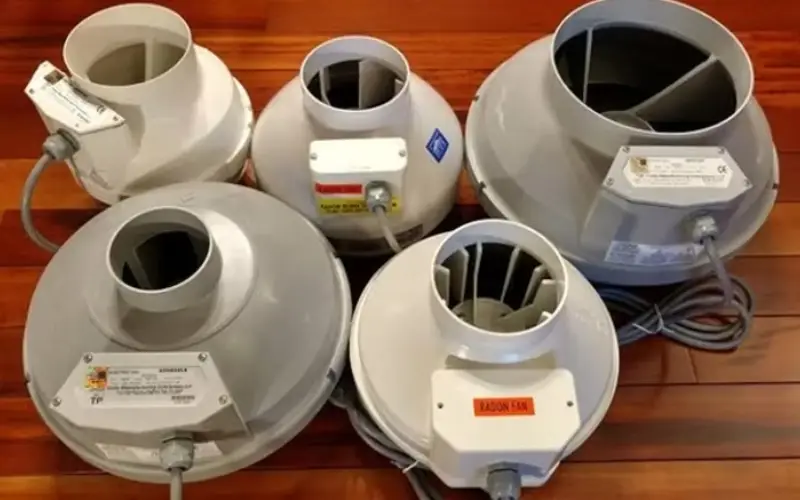
Talk to enough Central New York homeowners about their radon mitigation systems and a pattern shows up quickly. Almost everyone knows the fan is there. It sits tucked away in the basement or bolted to an exterior wall. However, very few people know what it is supposed to sound like. Fewer know how to tell when something has changed.
That gap in understanding is where small problems slip through unnoticed. In this guide, we break down the misconceptions we hear most often from local homeowners. We will explain why each myth is misleading. You will learn what to pay attention to instead.
By the end, you will know the difference between normal fan behavior and a change that deserves a phone call. You will also learn when testing and professional inspections matter.
Myth 1: If the Fan Is Running, Everything Is Fine
This is the easiest assumption to fall into. You hear it humming and know it has power. Then you go about your day without a second thought. Actually, a failing fan with seized bearings audibly hums but the fan is not turning at all, just trying to.
A running fan does not tell you if the system performs well. The motor might operate at reduced efficiency without you noticing. Perhaps the fan was undersized at installation, not able to properly reduce the radon, this is a common issue. System pressure can also drift over time. A pipe connection might have loosened just enough to leak. Movement is not the same as proper performance. A spinning fan can still require a closer look.
Myth 2: Radon Mitigation Fans Never Need Attention
These fans are built to run continuously. That constant operation makes them easy to forget. It is true, they are sealed units and the fan motor and bearings are not serviceable.
However, continuous does not mean flawless forever. Motors and bearings wear down over time. Electrical components develop faults gradually rather than all at once. Fans often become noisier or vibrate differently as they age. Most changes in a radon fan happen very slowly, making them hard to catch until just before total failure.
Pay attention to small changes, especially increasing noise. Do not wait for the day the fan completely quits. A minor shift is always cheaper to investigate than a total system failure.
Myth 3: A Noisy Fan Must Be a Powerful Fan
A strange bit of logic creeps into people’s heads here. Homeowners assume a loud fan works extra hard to protect them.
In reality, the opposite is true. Unusual noise is a warning sign, not a badge of strength. Rattling, grinding, buzzing, or sudden vibrations point to mechanical wear. They do not mean better radon reduction. A well-matched fan moves air quietly without struggling.
Myth 4: Any Radon Fan Can Be Used as a Replacement
This myth genuinely costs people money. Radon fans are not one-size-fits-all replacements. Models may look identical on a retail shelf or webpage, but their internal specs differ.
The right fan depends on your specific mitigation system layout. It requires matching your pipe configuration, airflow requirements, and pressure conditions. Before you shop radon mitigation fan options online, you must understand what your existing setup requires. A fan that looks suitable in an online listing may be a terrible match for your home.
Myth 5: Once Radon Levels Are Low, Testing Is No Longer Necessary
A low reading after mitigation is a great sign. However, that result does not automatically last forever.
Homes settle and shift over time. Mitigation equipment ages. Fans eventually need repair. Ground conditions around your building can also change. Testing gives you accurate data right now instead of relying on old assumptions.
Keep these critical testing rules in mind:
● Homeowners looking into radon testing in Syracuse in Central New York should treat it as an ongoing habit, not a one-time chore.
● Test again after any significant repair to your mitigation system, even if nothing seems wrong.
● If the fan’s operation sounds or feels different than usual, test your air immediately.
Myth 6: Replacing the Fan Means Replacing the Entire System
Thankfully, a failing fan does not mean your whole system is trash. Often, your PVC piping and structural seals remain in perfectly good shape. The issue is strictly contained to the fan itself.
Other times, a professional inspection turns up minor pipe cracks worth sealing. Either way, a technician must diagnose the exact failure before replacing parts. Treating every fan issue as a full system overhaul wastes money and skips the simpler fix.
Myth 7: A Small Change in Fan Noise Is Nothing to Worry About
We hear this constantly because the noise change seems minor at first. Maybe the fan sounds a touch louder this month. Maybe a faint vibration appeared that was not there six months ago.
It might turn out to be minor, but do not shrug it off. Mechanical equipment almost always gives clues before it fails completely. If you are already planning to shop radon mitigation fan equipment, get your current system evaluated first. This saves you from buying a replacement based on guesswork alone.
A Little Attention Can Go a Long Way
Your radon mitigation system protects your family’s health. Treat the fan as more than a forgotten box in the utility room. You do not need to be an expert in airflow or electrical motors. Just learn what normal sounds like, notice when things change, and call a professional when something feels off.
Conclusion
At A Best Radon Systems, we help Central New York homeowners understand their equipment. We quickly diagnose whether a repair, a replacement, or a simple inspection is the right path forward.
If your fan has gotten noisy, behaves strangely, or has run for years without a checkup, let us help. Reach out to schedule a service visit today. We will ensure your system keeps doing its job safely. Learn more at abestradonsystems.com.